
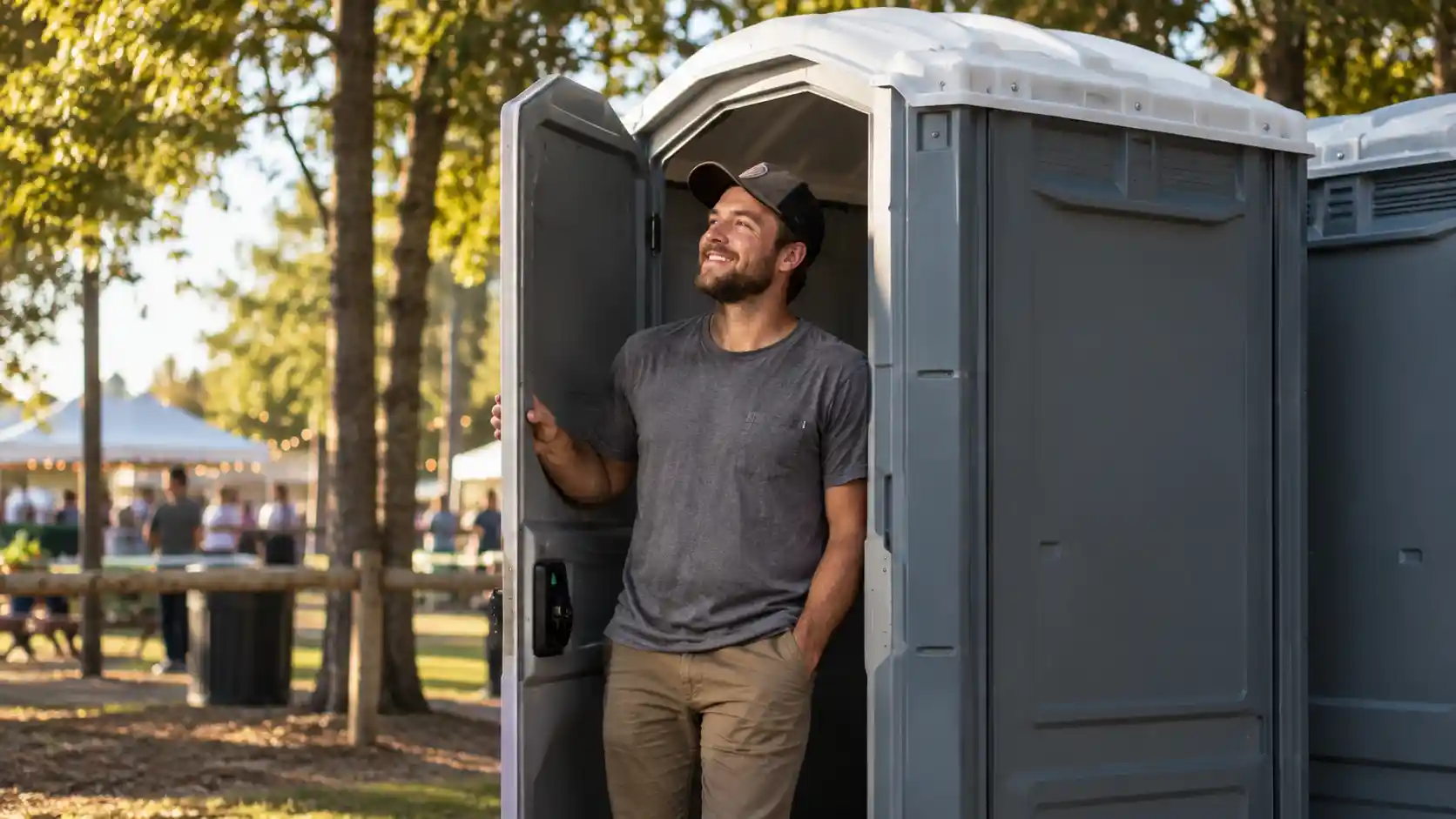
You’ve booked a stunning Hudson Valley barn, a private Hamptons estate, or a Brooklyn rooftop. The florist is confirmed, the caterer is locked in, and the guest list is finalized. Then it hits you: the venue has one indoor bathroom.
And 180 guests are coming. Undersupplying restrooms is one of the fastest ways to turn a beautiful New York wedding into a story guests tell for the wrong reasons. This guide gives you the exact formula wedding planners use to calculate porta potty and restroom trailer needs, plus the factors that quietly push those numbers higher.
Portable toilet planning for weddings is based on the number of guests, event duration, and expected restroom demand. The goal is to keep waiting times under five minutes throughout the event.
Portable Sanitation Association International (PSAI) recommends a minimum of one standard portable toilet for every 50 guests at a 4-hour event. However, this is only a baseline. Most weddings last 5 to 7 hours or longer, covering cocktails, dinner, and dancing.
Alcohol also increases restroom use significantly, often nearly doubling demand compared with non-alcoholic events. For this reason, weddings usually require more toilets than the minimum standard.
Before you calculate, know these three inputs:
Miss any one of these and your estimate will be off.
Here’s the calculation most New York wedding planners use as a starting point. Numbers assume alcohol is being served and the wedding runs about 5 hours.
Guest Count | Standard Units (Alcohol, 5 hrs) | Recommended VIP Trailer Setup |
25–50 | 2 units | 2-stall trailer |
51–100 | 3 units | 2-stall trailer |
101–150 | 4–5 units | 2 or 3-stall trailer |
151–200 | 5–6 units | 3-stall trailer |
201–300 | 7–9 units | Two 3-stall trailers |
301–500 | 10–14 units | Two 4-stall trailers |
For most weddings above 100 guests, couples upgrade from standard units to deluxe flushable porta potties or a VIP restroom trailer, the difference in guest experience is significant, and we’ll break down when each makes sense below.
Base counts assume an “average” wedding. Your wedding probably isn’t average. Every factor below pushes your unit count up.
Guests visit the restroom 30–40% more often when alcohol is served. An open bar means longer visits and more frequent trips. Add roughly 20% to your unit count if you’re serving alcohol; 25–30% for open bar events lasting more than 5 hours.
Every additional 2 hours beyond the 4-hour baseline adds another unit per 50 guests. A 7-hour reception for 150 guests, for example, isn’t just “a little longer”, it’s a real jump in restroom demand.
Full plated dinners and heavy hors d’oeuvres increase restroom visits. Coffee service after dinner triggers another wave. Add one extra unit per 100 guests when you’re serving a full sit-down meal.
Older guests, guests with young children, and pregnant guests use restrooms more frequently. If your guest list skews toward extended family, add one additional unit per 100 guests.
If your venue has zero indoor plumbing (barns, private estates, tented backyards), your portable units are the only option. Don’t cut it close, add one extra unit as a buffer.
A VIP restroom trailer is a climate-controlled, multi-stall portable restroom with running water, flushing toilets, real fixtures, and finished interiors. Standard porta potties are single-user units with a holding tank and hand sanitizer.
For most New York weddings above 75 guests, the trailer wins on guest experience. But cost, venue access, and setup requirements matter too.
Feature | Standard Porta Potty | Deluxe Flushable | VIP Restroom Trailer |
Guest capacity per unit | 1 person | 1 person | 2–8 stalls |
Flushing toilet | No | Yes | Yes |
Running water sink | No | Yes (small) | Yes (full) |
Climate control | No | No | Yes (AC + heat) |
Interior lighting | Minimal | LED | Full lighting |
Best for | Backyard, casual | Small elegant events | 100+ guest formal weddings |
Setup requirements | Level ground | Level ground | Level ground + power + water hookup or onboard tank |
Get clean portable restrooms delivered for your event, job site, or temporary project.
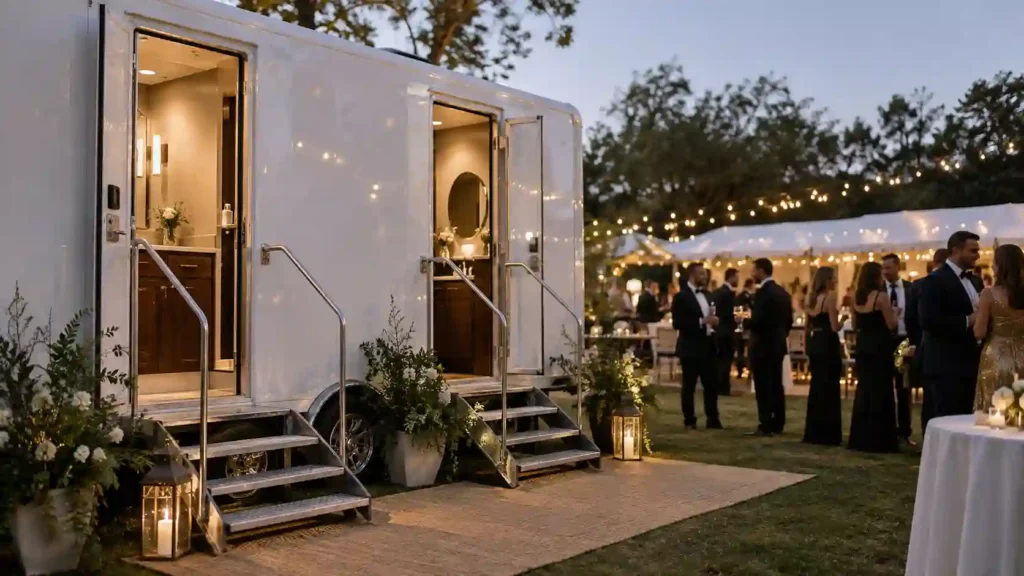
Choose a VIP restroom trailer if:
Standard units make sense for smaller, casual outdoor weddings under 75 guests where the vibe is relaxed. Deluxe flushable units are a strong middle ground for weddings up to about 100 guests where you want more than a construction-grade unit but don’t need the full trailer footprint.
Yes. Any wedding open to the public, held on public property, or hosting guests with mobility needs should include at least one ADA-compliant unit. An ADA-accessible porta potty is a wider, ground-level unit with enough interior space for a wheelchair and a companion.
Even for private weddings without formal ADA requirements, it’s the right thing to do. Elderly grandparents, pregnant guests, and anyone with a temporary injury (that guest on crutches) will thank you.
Source: ADA restroom accessibility guidelines
Weddings held in public parks, on beaches, or requiring street closures in New York City often trigger permit requirements that mandate ADA restroom counts. In NYC, events on Parks Department property have their own sanitation ratios you’ll need to meet. Always check with your venue and local municipality before finalizing your rental order.
Placement is as important as quantity. Poorly placed units, visible from the ceremony, blocking photos, or too far to be practical, ruin the guest experience even when the count is right.
After servicing hundreds of Hudson Valley, Long Island, and NYC weddings, we see the same avoidable mistakes:
Your wedding day shouldn’t come with a restroom problem. Empire Porta delivers clean, well-stocked porta potties and luxury VIP restroom trailers to weddings across all of New York, from Hudson Valley vineyards and Long Island estates to Brooklyn rooftops and Adirondack lodges.
Here’s what you get when you book with us:
📞 Call (332) 316-1255 for same-week availability and wedding pricing
🔗 Get a free quote: empireporta.com/contact-us
For a 100-guest wedding lasting 4–5 hours with alcohol service, plan on 3 standard porta potties or a 2-stall VIP restroom trailer. If your reception runs 6+ hours or is a full open bar, upgrade to 4 units or a 3-stall trailer to keep wait times comfortable throughout the night.
Book your wedding restrooms at least 4–6 weeks in advance during peak season (May through October in New York). VIP restroom trailers have limited inventory and often sell out first. For off-season weddings (November through April), 2–3 weeks of notice is usually enough.
Getting your wedding restroom count right is one of those planning details guests never notice when you do it well, and never forget when you don’t. Use the base formula (1 unit per 50 guests for 4 hours), adjust for alcohol, duration, and demographics, and lean toward a VIP trailer once you cross 100 guests. Then book early, confirm placement, and let the details fade into the background so your day can unfold the way you planned. When you’re ready for a quote, Empire Porta covers weddings across every corner of New York.

Daniel helps homeowners, contractors, and event planners choose the right portable restroom setup for their needs. He focuses on practical placement, reliable service, and making every rental experience simple from delivery through pickup.